After Moses
I read “After Moses” by Michael Kane, and it was a delight. This is a good novel, and I expect a good series, to share with your teen boy. The author calls it space western, in the vein of Firefly, but I also got distinct Cowboy Bebop vibes. However, the hero is a very welcome aversion of the usual cynical captain. I won’t spoil anything, but you’ll probably figure out where hero Cole comes from before the reveal, and the concept is a delight. The setting is also unique and fascinating.
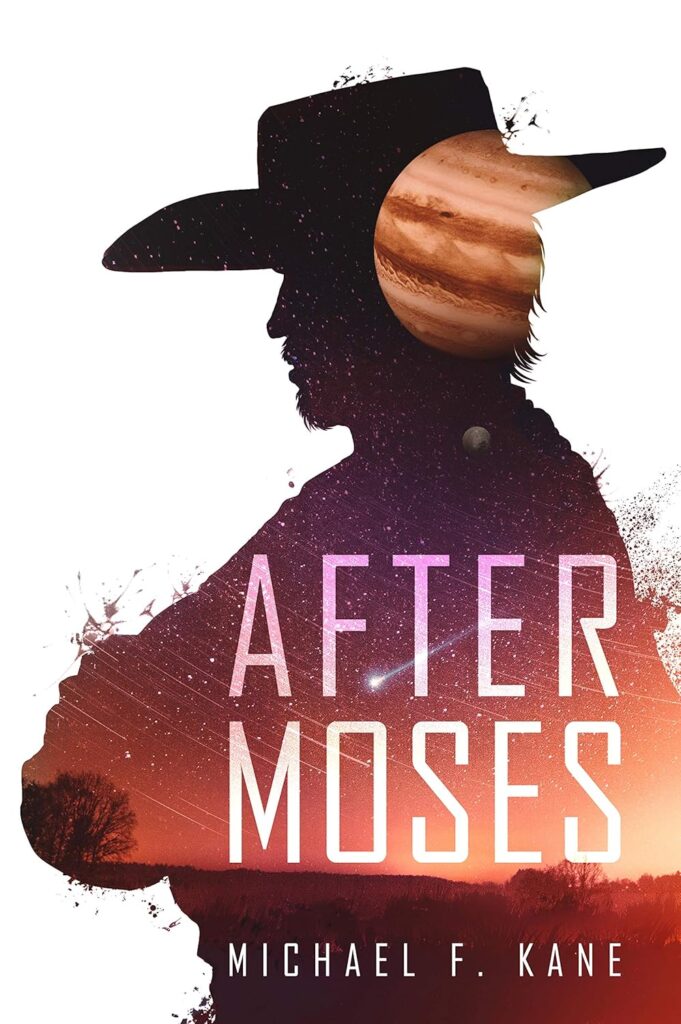
Overall, this is a pulp-style sci-fi adventure story in an episodic format, as our hero slowly collects about himself the standard rag-tag crew and they take on one job after another in post-apocalyptic solar system. Over the course of several gigs, the heroes and their captain are drawn toward the central mystery of the series, which is tied into the setting’s unique conceit: This is not an AI story, but a post-AI story. The AI was not the cause of the apocalypse, but the cause of a hundred years of utopia—and then it vanished, leaving humanity’s nascent space empire cut off from its roots. Where did Moses come from? Where did it go? Can humanity survive without it? Who is the Unchained Man, and what is his interest in the missing god? And what is his purpose for our captain, Matthew Cole, whose personal ethic and worldview are diametrically opposed to the nihilism of his age and his mysterious benefactor/malefactor? Cole is not a man of lost faith, not one of those whose morality is a personal conviction without grounding. He knows what he believes, and to what he is dedicated. He is just waiting to find out what his true mission is, after his first mission ended in failure. He is waiting to find out why a man of his path should also be a talented killer. (It is interesting and refreshing also that the author chooses to resolve Cole’s one big tragic background issue in this, the first volume of his series, leaving Cole utterly focused, rather than conflicted, for whatever comes next.)
I do have quibbles. Objectively, the prose is relatively well-polished, but there are still some typos and misused words in this first episode. Subjectively, the narrative voice is rather informal and colloquial. When the narrator is a third person omniscient, I believe, its voice should be generally formal (not stilted, but professionally artful, not given to colloquialism or informalities), as it distracts, makes you wonder to whom you are listening, and detracts from the distinction between narrator and in-world dialogue. Related, the characters—even the teenagers—are given to rather writerly turns of phrase and vocabulary. The author would not go amiss to consider the manner of speaking of each character, especially the children.
The ebook also is formatted with block paragraphs, which is a bugaboo of mine. I believe narrative prose should be formatted in unseparated, indented paragraphs, as these flow better and don’t introduce the subliminal staccato choppiness which the block paragraph does. We are not writing business letters or Internet copy. We are crafting a smoothly flowing narrative which should run like a river, broken only occasionally and intentionally.
Finally, this novel knows what it wants to be, and who is its audience. The scenarios, characters, and conflicts are relatively simple. This is an adventure novel and is meant to be accessible and an easy, entertaining read rather than challenging.
Now, I suspect that over the following four volumes, the author continues to refine his craft, and his choices are his regardless. In any case, quibbles are only quibbles, and this is a good story and great escapism for the whole family. (I won’t even bother with the parental advisory, as the author provides one. Suffice to say, highly recommended to your young folk. Thank you, Mr. Kane!) I look forward to finishing the series. Recommended.