Autonomous Weapons Division: Intrusion Protocol
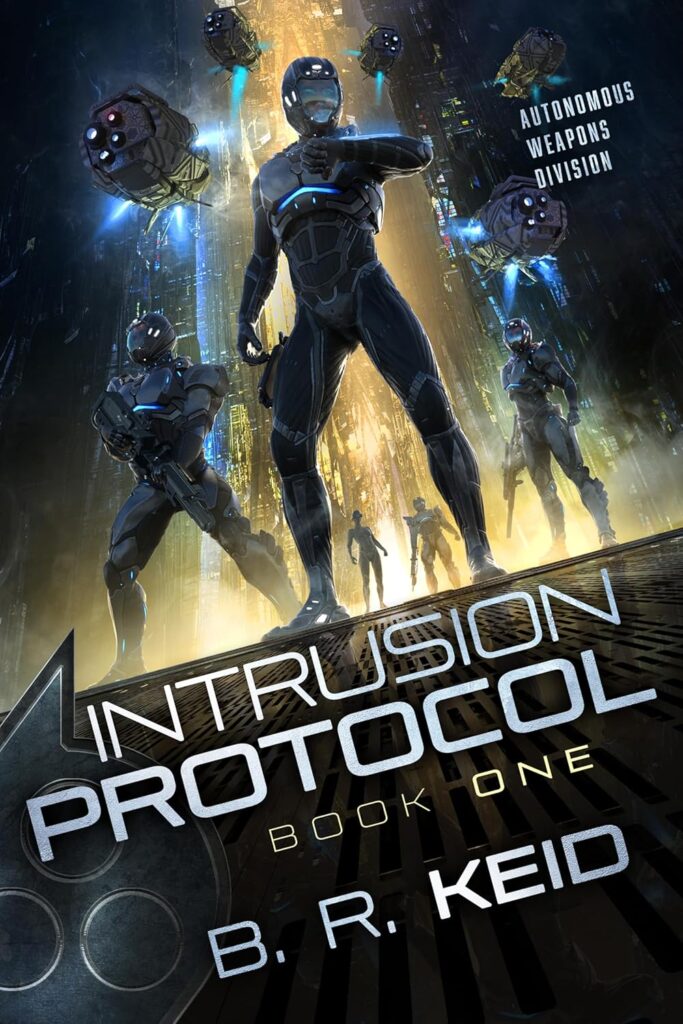
I read “Intrusion Protocol,” the first book in the “Autonomous Weapons Division” series by B. R. Keid, and I’ll be honest: I slammed it. Read it in one day, stayed up late to finish.
Now, there are a number of ways, as an author, that you can work your way into making up a great story. Here’s one, purely hypothetical: Let’s say you’re a big fan of Halo, and played it growing up. Love the game, the story, the lore. You’ve got that naturally creative mind that, as a kid, starts imagining side-stories or alternative plots to it. Maybe some self-insert day-dreaming. This is fan-fiction in your mind, and maybe you write some of it down. Maybe this fan-fic is how you cut your writing teeth. But the more you think about it, you see the problems with the original, the little issues here and there, the ways, in your less than humble opinion, you think it would be better if they had just done this, just done that, instead. You embrace these improvements mentally, and your version of it evolves and evolves until it is something truly new. There’s still a family resemblance, but your story is no longer that story. Your story is now truly original, a different plot with different characters in a different setting, with different themes and a different feel.
This process is not unique to writing, either. Some of the greatest musical compositions are the works of a composer “remixing” someone else’s motifs and orchestrations the way they think it ought to have been until the result is a genuinely new work, appreciable on its own merit, even though the well-educated listener can detect on what original source the new composer is improvising.
I’m not saying that’s how the world of AWD came to be. I’m just saying that’s one way a story can come to be, and it can produce some of the best new material you will read. I loved Intrusion Protocol’s setting. Fit this one generally in the category of “distant post apocalypse:” We are seeing the remnant of humanity, scraping by in a distant, sheltered corner of the Milky Way, centuries after whatever great alien invasion and intragalactic war nearly wiped us out and did lose us the Earth, such that the war, and even the Earth itself, have become the stuff of mythology. Like the best of military sci-fi, the military bits are hard and crunchy, and the science bits are loose and fun. Soldiers fight in powered armor with plasma rifles, riding drop-skiffs from FTL-capable motherships just like your favorite cinematic military sci-fi videogame. AIs are personality constructs, to the lay person indistinguishable from sentient human personalities, running on cybernetic implants in the brains of, and cohabitating with the minds of, their programmer-operators. The melding of man and machine is finally coming to full fruition for humanity, with all its implications.
Interestingly, and to carry on that theme, the enemy is an ancient alien threat which followed the same technological trajectory centuries or millennia prior, and so previews the end of it: an integration of the organic and the technical so thorough that its natural hive mind and its digital hive mind are no longer distinguishable. Do their machine artifacts reflect their nature, or did they become what they became in spirit because of what they made themselves technologically? And what did they become? What is the true nature of the seemingly demonic spirit animating them, framing their rapacious culture around all-consuming cultic worship of ancient alien gods? Did their technology create their religion or shape it? Did their artifice create the abomination they worship, or open a door to it?
And if they still worship The Eleven, then who is the Twelfth whom the human society still vaguely remembers as its savior?
All excellent questions which make me anxious to continue the series. This is a very good treatment, maybe the best I’ve read, of what we might call techno-Lovecraft: eldritch horror by means of technology. Meanwhile, the pace and polish are everything you expect from professionally-crafted commercial fiction. This book starts with a space explosion, allows its characters a few hours downtime, and then drops directly into The Mission, which consumes the rest of its wordcount aside from an extensive (but welcome) denouement at the end. This is the story of essentially one very bad, relentless day, and plays like a movie. Think “Aliens,” in terms of pacing and structure. Also like “Aliens,” characters here are relatively simple mil-fic archetypes, with relatively simple motivations, but treated well and given humanity, and our protagonist comes with a twist (the five AI voices in his head) and a surprise (which I will not spoil). The relationship conceit is a classic: Our protag is The Tech, the non-warrior, who suddenly finds himself embedded with The Team downrange, no longer safely behind his computer screen. You can’t do better, as device for integrating the nerdy-normie consumers of mil sci-fi into your world. The nerd learns to get along with the jocks, the jocks learn to value the nerd, the nerd toughens up a bit, the jocks soften a bit, and it also, very valuably, allows the reader to come as an outsider to the crunch military stuff with which he may not be familiar without being hedged out by its technicalities. I would use the same device, and have done, and we are in good company. Tom Clancy’s legendary Jack Ryan series was basically the same trope.
Overall, then, well-crafted and very entertaining, and provocative of the imagination.
My only caveat is to the Christian readers: This is not a Christian book.
Your first clue is that sex is a casual pastime here, even for our nerdy protag, such that there is no love interest, just a James Bond-style sexual diversion in the form of a fully objectified cute girl whom he wants to bang at the beginning and is rewarded with banging at the end. The sex is handled off-screen, and is not in any way essential to the story (it is, in the most literal and complete sense, gratuitous), but the sexual ethic is essentially that of James Bond, so not for your kiddos, unless they are mature enough to have a good discussion with you about how this kind of sexual transactionalism is the natural product of a technologically advanced pagan society, and why, though common in carnal, escapist fiction, it inevitably evolves toward cultural horror (a society of sexual human sacrifice) in the real world. We are all living through the age of realization that human beings can’t have casual sex, because sex was not made to be casual. The one thing our science-fiction writers failed to predict is the human dimension: what the human creature becomes, and what his society becomes, when he devalues sex until it is essentially equivalent to ice cream, maybe to be procured with a friend from your favorite ice cream parlor, maybe to be grabbed from the gas station freezer, and only rarely made from scratch at home by a few odd traditionalists who swear their ice cream is better but you can’t see how it could be so much better as to merit all that work. Every Christian, these days, should be educating his children to understand that the sexual ethic which made James Bond novels famous and created a cultural phenomenon out of the phrase, “It’s no big deal,” was actually the same which produced the sexual revolution, the explosion of pornography, then alternative sexual identities, and alternative gender identities, which has led us to the brink of trans-human/post-human civil war today. “But it’s just a throw-away scene, and not really important to the story. It’s not a big thing with this book. It’s no big deal.” Yes, but that’s the point: it was making sex a small thing that got us here. Sex is deeply tied into our being, and we cannot lessen sex without lessening our humanity, it turns out. And lessening our humanity is, ironically, one of the pivotal themes and warnings of this novel. As a Christian adult who understands all of this, you can probably read past this like you watch past the gratuitous sex scene or implied sex scene in a typical movie, but we have learned that we can’t trust our children to do the same. Omissions are just as formative for them as inclusions, and including sex while omitting its value, over and over again in little throw-away scenes, was a principal tool of the sexual revolutionary to program a generation to see sex exactly that way, as no big deal. Unfortunately, Christian parents can’t be complacent about such things any longer, in media their children consume. We never could, really; it’s just only now that we are realizing it.
And this leads me to my second caveat for the Christian audience, the second clue that this is not a Christian book: It’s not a Christian book. No one in this story, neither the characters nor the narrative voice, has any awareness of Christianity, nor memory of it. This is the story of an essentially pagan future human culture, a bit like the world of “Battlestar Galactica,” and it displays the same odd epistemological blinders which all pagan societies do. You’ll be familiar with what I’m talking about. Now, we must acknowledge that the modern pagan is, generally, not self-consciously pagan. He doesn’t consciously worship a pantheon of gods. He doesn’t consciously worship anything. He just knows he’s not convinced by the monotheistic moral-God theory, even if he has a sense that there is “something” beyond the material of the world. As such, he falls into pagan practice unconsciously.
The first of these is that when he imagines the supernatural, he imagines gods, not God. God is generally too confining, and gods are much more interesting, with their interplay and dynamism. Gods make for an interesting story, and open the door to the Lovecraftian delights we enjoy in our horror. Plus, there is a certain carnal attraction to the worship of gods, with their weird cults and ritual practices—not to mention, in most cases throughout history, plenty of sex, though we moderns, even given to casual sex as we are, can’t imagine what “sex” was to the pre-modern man. One thing I didn’t mention above: if you want to know where the end of the sexual revolution lies, look back to our history. Here and here are good places to start. This novel is not about sex, except the gratuitous bookends mentioned above, but it is a speculation about gods, and where religion comes from and what religion is, and in this book, religion, even the religion of the humans, is either unconsciously pagan or consciously pagan.
And this leads naturally to the second: He applies to himself assumptions, especially moral assumptions, that can’t be derived from the gods, and in fact have no source in human knowledge other than Christianity. For instance, the humans in this book operate on an assumption that slavery is bad. They are not a slaving society. This is a Christian inheritance. No human being outside the Christian context has ever considered slavery to be abnormal, much less an abomination to be eschewed. Likewise, the human males in this book’s human society seem to treat women as equals and value them as such, even if they also occasionally view them as dessert. Where did they get this idea? Humans didn’t invent it. No human thought this way until Christianity infected the human metamind. How do they remember this, and take it for granted, if they have no Christian history? Naturally most people have no idea that this is a uniquely Christian assumption, much less that the idea of women as valuable evaporates the moment the Christian framework is removed (though Western people are starting to see that, today, in real time). Most people just assume that ideas like the value of women and slavery as evil are a product of some kind of natural evolution of moral awareness—which belief is a product of secular humanist/materialist theories which guided their education but which were never true, and can’t be anthropologically supported. Indeed, if you think about it, the entire science fiction genre is this, not just its moral component. The very “science” in science fiction is the idea that the universe is a cosmos, governed by discernable universal laws—indeed, not just universal but unified, really a single, integral Law of immense complexity but perfect internal consistency, which any sentient being anywhere in the universe can understand and harness for its own thriving or the thriving of others. In fact, one of the basic definitions of horror in the science fiction age is the idea of the natural laws “breaking down” or being violated, thank you Lovecraft. The natural law is taken to be so inviolable that its violation is regarded as the definition of impossible, and therefore imagining its violation the definition of madness and horror. Where did that idea come from, eh? Care to guess? Care to guess whether such a concept of Nature as governed by a single, integral, inviolable law from one end of the universe to the other has ever arisen in the human sphere outside Christianity?
Which leads, finally, to the third and perhaps most esoteric epistemological blinder of the pagan: It is very hard for him to get at the root questions, and this difficulty increases the later you go in history, i.e. the more scientific knowledge he has at his disposal. As the scientific acumen of a society increases, its philosophical intelligence decreases. Very early pagans had no problem conceiving of a singular source god as the creator of all the other gods and the heavens and the earth. They may have debated the creator’s qualities or attributes, but the proposition of such a god did not cause them any problems. If they did not imagine the root source of existence as a god, then they at least concerned themselves with the question of what lies at the foundation of reality. Plato’s and Aristotle’s works on this question are still read today as foundational in a student’s education in how to think. However, once the sciences were born, and questions of how the material universe works began to be answered, the greatest minds turned to questions of material mechanisms and laws (taking for granted the one Great Discovery that gave rise to science in the first place: that one of the chief attributes of the root of existence was that He is Law, and so made the world out of Law Itself, which is why we can expect to find it governed from its fundaments by a single unified law), and they lost their ability to address the source of these material mechanisms and laws. This has led to the very curious situation wherein some of the most brilliant minds of the twentieth and twenty-first centuries can unfold physics problems of astronomical complexity and staggering insight, yet when they turn their efforts to the questions of fundamental reality, their reasoning does not pass a freshman-level logic course. See the philosophical flounderings of Stephen Hawking and Einstein, to say nothing of their far less intelligent successors like Dawkins, Sagan, and Hitchens. They literally can’t see the problem. It blinds them. And why? Perhaps they don’t like where science points, to the extent that science does make suggestions regarding the questions of ultimate origin, in terms of the existence of universal physical laws as mentioned, and the fine tuning of the those laws (or the universe-generating mechanism), the extreme unlikelihood of Earth itself even within such a fine-tuned universe, and the mysteries of the emergence and development of life on Earth, the nature of life, the elusive problem of consciousness, and so forth. “Your math is impeccable, but your conclusions are abominable.”
This third blinder very clearly expresses itself in modern paganism and pagan science fiction: The authors simply ignore the question of “Why.” From Asimov and Heinlein to today, they speculate about what will happen, and often on what should happen, but never try to address why anything should happen. In the same way that they assume without question that human beings should not take slaves, and so never discuss why humans shouldn’t take slaves, or why the fundamental moral propositions are true which lead to that conclusion, they write great epics about the future survival of mankind without ever asking why mankind should survive, or why one vision for mankind’s survival (say, a free society) might be in some transcendental way more “good” than an enslaving hive mind society which they often portray as much more suited to any material definition of success: survival, propagation, and self-perpetuation. And when these authors do turn to questions of metaphysics, and speculate on matters spiritual, their pagan mindset of course inspires them to imagine a pagan metaphysics of eldritch gods—and in the process perfectly demonstrate what I’m talking about: The more modern the pagan, the more he imagines the gods to be things within the universe (or multiverse, allowing them to be “extra-dimensional,” but the concept of a multiverse is really just a way of expanding the bounds of the universe, conceptually). Pagan gods were always things within the universe, but often in ancient conceptions occupied a more complex cosmos that incorporated the realms of the dead and the gods beyond the world of the living, beyond a veil. It takes a modern materialist to place the gods in outer space, or in cyberspace, or in an alternate dimension of the law-governed universe.
Look what he has done when he does this: He has explicitly made the gods into created beings. He has made them ontologically subordinate not just to existence but to material existence, a feature of the universe. He has taken them from being even potentially participatory in the creation of the world to being a function of the world. In other words, modern Lovecraftian paganism is the complete flight the question of origins and the root of existence, by which we drag down even the pagan’s only access to the transcendental (the gods) and make it part of the material world we can explore with science, and then…
…just ignore the question of why any of it exists in the first place, and why it is all governed by a Law, and why the Moral Law we take for granted seems to tie so naturally to the Natural Law we observe, and why even the gods must obey that Law, and why violation of the Natural Law seems to correlate so naturally to us with violation of our instinctively recognized Moral Law.
These are the kinds of discussions that come to mind when I read a story like “Intrusion Protocol.” They are the kinds of discussions your offspring should be mature enough to have if you are going to recommend it to them. And these are the kinds of questions that will drive me to continue the series. Book One is pagan. But I don’t know the author. I don’t know if he is pagan. When I read this, as when I read Lovecraft, I want to continue, to find out how the author handles what he has wrought. As he develops his world, does he continue to turn away from its metaphysical implications, or does he face them and grapple with them? Can he perceive them at all? And will he succeed at following through to its conclusion the logic which he has initiated?
“Intrusion Protocol” is highly entertaining, and it is interesting. I will be continuing the series to find out where the author goes with his ideas—even the ideas he doesn’t realize he is proposing.