Travel by Star
I read Travel by Star, by Paul Scott Grill, and I’m giving it my first five-star review.
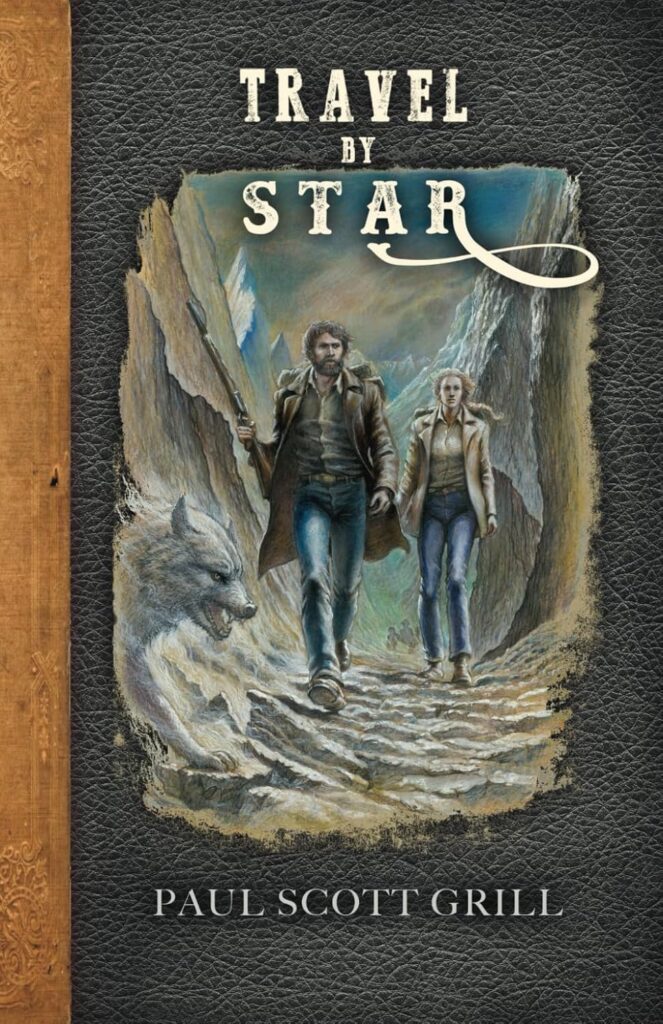
Now, what does that mean, “five stars?” For our purposes here, the scale is this: Three stars is a book you could miss and not miss anything. Four is a book you should read. Five is a book you must read, and probably share with others. (Two is a book you shouldn’t read, and one star would be a book you must shun for the sake of your health.)
Right, now that we have that out of the way: Why do I say Travel by Star is a must-read? Well, it just is. It’s well-written (with a caveat we’ll discuss in a moment), clean and polished, a beautiful story with engaging characters who defy tropes, stereotypes, and genre expectations and are well and realistically developed, wholesome and uplifting themes, gritty subject matter (Grill does not shy away from his heroes’ past sexual immorality and the toll such behavior takes, though he handles it deftly to keep the work appropriate for the teenage audience), fantasy elements that aren’t overbaked, adventure elements that keep on coming, and a gripping conclusion. Even its pace is on target: measured and thoughtful, almost plodding, but not in a boring way so much as a meditative way. One might say in the way that a horse carrying its rider steadily, mile after mile, through hill and dale, over field and mountain, is measured and steady and hypnotic, leaving the rider’s mind to wander into memory and contemplation. Travel by Star carries itself along at the pace of what it describes, a long journey on horse-back, its punctuating adventures interspersed with vital flashbacks and introspection which build our characters as they travel. It’s a throwback to adventure fiction that did not feel the need to keep the wired in like a cocaine fix because its readers did not back then have the attention spans of social-media-addled pre-teens. I have seen the pace called slow, but the pace here is just right, just fitting. I believe Grill has written a story that will remind you of why you enjoyed reading fantasy and adventure when you were young and will thrill, inspire, and stick with your own young ones, as long as you and they are readers, not brain-damaged addicts.
Pretty good, right? More specifically, a few qualities I particularly appreciated:
The fantasy in this fantasy is deftly handled. It is not “high fantasy,” in that its worldbuilding (magic systems, fictional physics, and world map) do not take center stage. There is a map, but it’s very simple and doesn’t tell you anything you won’t get from the narrative. The novel would work just as well with no map provided. Likewise, there are hints that the “magic” powers which certain gifted characters possess fall into systematic categories, but the categories are never elaborated. The author feels no need to iron everything down into a videogame or some sort of Aristotelian-level explicated metaphysic. We stay with the characters, in the moment, and see the results of the supernatural, but the supernatural remains that, wondrous, rare, and not the star of the show. Neither, however, is it “low fantasy,” in that it is an entirely fantastical setting. This is not “magic around the corner” in the otherwise real world. This is a fantasy world, with fantasy elements, from top to bottom. Now, what does that remind you of? Are you thinking Tolkien? Are you reluctant to say it because comparisons to Tolkien are too pat, too cliche, and too coveted to take seriously? Nonetheless it’s true. This story takes a–hold your breath, now–Tolkienesque–approach to fantasy, and it’s just right for the story. But it’s not Tolkien, it’s a western! Or at least, it’s sort of western or northwestern in flavor. And that’s another reason it works. The stories that try to be the new Tolkien fail. But the stories that try to be themselves can do things that work, things that have worked in the past in great examples such as LotR, and benefit from them. To say Travel by Star‘s fantasy is Tolkienesque is not to say too little or too much, but only that. It works in the same way that Tolkien’s worked, by being thoroughly fantasy without feeling like a modern fantasy feels, all system-y and navel-gazing and obsessed with its own internal physics.
Also nicely handled here, not for its deftness so much as its boldness, and another dare-I-say-Tolkienesque quality, is this story’s Christian identity. Travel by Star is not a story with Christian themes, any more than LotR was. Rather, it is a story which assumes the truth of Christianity, somewhere in the background, and doesn’t feel compelled to argue the point. Take it or leave it: Christianity is true, that’s the root of the universe, and so defines the moral and metaphysical facts of reality, and the story is concerned with what takes place in that reality. That’s lovely because it makes it not Christian fiction, per se. Christian fiction is, as we all know, terrible. But it’s terrible because it spends effort defending its Christianness. Tolkien never did that. Neither did Dostoyevsky, either. Should we shy from that comparison as well? Dostoyevsky’s “Christian” fiction was Christian just in that it assumed Christianity, and so Dostoyevsky could confidently allow even his “Christian” characters to be miserable bastards, predators, even atheists. Which is to say he felt no need to shy away from the human evils that persist even in nominally Christian societies, but neither felt he any need to hand-wring in the narrative voice about how these are not true Christians, or true Christianity, nor likewise felt he any need to justify these characters. If they were evil, they were evil. He neither denied it nor made a Sunday school class out of it. He simply explored it. He dove deep into the psychologies of evil and broken people. In the same way that Travel by Star is not “the next Lord of the Rings” (a phrase which has no meaning), it is not “the next” Brothers Karamazov or anything else. It’s its own work. But again we can say that it successfully does a good thing which as been seen done in the past, by the likes of no less than Dostoyevsky: to wave away the discussions of Christianity as a foregone debate, assume the results, and get down to more interesting and edifying business: Being honest about its characters, and unflinchingly exploring their tragedies and how they got themselves down these dark roads. Truthfulness in character is most possible when the narrative voice can take for granted that moral truths exist and have already been established, that the narrator and reader already are well familiar with them, and they don’t need to be rehashed or defended. So, Travel by Star is not Christian fiction, but something much better: fiction which assumes that you assume Christianity is true.
(“But what if I don’t grant that Christianity is true?” Then you can refrain from reading a great story. That’s your choice. Nobody’s got a gun to your head. You don’t have to read Dostoyevsky or Tolkien, either, while you’re at it. Have a nice life.)
So, does all this stratospheric comparison to greats such as Tolkien and Dostoyevsky mean that Travel by Star is a perfect book? No. First of all, the comparisons aren’t actually stratospheric. That’s the point I was getting at earlier. They’re simple and grounded. Tolkien’s and Dostoyevsky’s works are towering landmarks of literary history, but the reasons they work so well are decipherable and, at least individually, replicable, and I’m deliberately making these comparisons so we can knock some of the religious glow off them. You can do things that Tolkien and Dostoyevsky did that were good, and they will likely be good for you work, too. These are just very good examples of techniques that anyone can use. As long as you’re not trying to replicate those historic accomplishments, learning from them will only better you.
Second, a book doesn’t have to be perfect to do things well that past famous books have also done well. And a book doesn’t have to be perfect to be a must-read, five-star book. I said before that Travel by Star is well-written with a caveat, and we’ll talk about that now. I prefer to write reviews of works which inspire me to get on my soap-box, and this one did that by inspiring me to talk about the concept of purple prose.
You’ve probably heard the phrase. It’s an industry term of art for unnecessarily artsy, poetical language in a prose narration. It’s a fancy word where a normal word would do, and probably do better, or a big, complex phrase where a simple statement would do and do better. It’s saying that the dawn’s light coruscated across the night-shrouded shelters of a thousand quiescent hopes and forlorn longings, when you could just say the sun rose over the town. Or, it’s saying “the stars began to make their presence known.” How? How do stars “make their presence known?” I know how I make my presence know. I shout. I do something unusual that draws attention. Did the stars shout? Did they flash in an unusual way so as to draw attention?
Or did they just come out in the normal way when it got dark? If they just came out in the normal way when it got dark, then let’s just say that.
But why? See, here’s where editors fail us. Editors are so important to the prose art, but editors have lately betrayed their sacred duty. Whether selling out to wokeness or to commercialism, they have forgotten that their divine calling is to the service of the art. The editor’s job is not to make a story this or that, but to make a story itself, and the best form of. An editor who is woke won’t touch this book, but an editor, even an anti-woke conservative editor, who just wants to make things marketable won’t know how to do that with this book, because he doesn’t remember what a great novel is actually like. So he will say something stupid like, “If it doesn’t move the story forward” or “If it doesn’t serve the story,” it has to be cut.
No. That’s wrong. If it doesn’t serve the reader, it needs to be cut. There are a lot of ways to serve the reader. Moving the story along is one way. Giving the reader a new experience, for instance a vicarious sensory experience he can’t acquire in his own real life, is another. That’s a valuable thing. Inspiring the reader to consider ideas, especially elevated ideas of morality, spirituality, and his own ultimate destiny is yet a third, and perhaps most valuable of all. Sometimes, dear editor, it is right and proper for the narrative to pause and dwell on something which is strictly extraneous to the plot but which is nourishing to the mind and soul of the reader. Sometimes, even a turn of phrase, or a bit of poetry, has its own value.
It is, therefore, right and proper for a writer to pursue these things, to try them, to experiment and explore the full breadth of the art of the novel for the betterment of his audience. And the editor’s job is not to strip away everything but the raw sugar, the pure Colombian snow. A good meal is not pure sugar or pure cocaine. A good meal has many flavors, a variety of nutrition. The editor’s job is to help the author take out that which is not useful or beneficial to the reader. Moreover, the writer and editor together are not obligated to assume the reader is a typical member of the modern brain-damaged species of Homo formerly sapiens now amens. They may, as a unit, produce a work aspirational toward a healthy readership. A novel which will be appreciated by a future person who’s mind has healed of its modern maladies and can once again read proper stories.
How extinct is this form of editor. Which leaves the independent writer of some vision to go it alone, with no one to rein him in as he stretches the boundaries of his work sometimes to excess.
Purple prose is that unnecessarily poetical or ornate language which does not benefit the reader, usually because it is, in some essential way, either not true or not meaningful. Not true, as in the example above, the stars “making themselves known.” That’s not what they did, by any reasonable understanding of that turn of phrase. Or not meaningful, in that a poetical form is used to elaborate on something the base form of which has not yet been established. Going back to my example of the ridiculously-described sunrise, such a description you might get away with if you’ve spent a good deal of time establishing a description of the town, and of its people, and of the hopes and fears of those people, and the significance of this particular day which is now arriving as it relates to those hopes and fears. In that case, the poetry (though it could still probably stand to be leaned out a bit) might properly draw tight a complex moving mental picture which you’ve been building up and building up, so that your flowery description of the dawn’s significance highlights that last moment of anticipation before the big payoff. But short of that, such a description of a dawn is metaphor with no referent. It’s just a writer playing with words because it’s fun.
That’s what purple prose is. A writer may serve any number of purposes, moment by moment throughout his narrative, and, no, he is not limited to just “moving the story forward” at a breakneck pace that keeps the reader hooked. Indeed, good literature is handicapped by this approach. A story needs to advance most of the time, but sometimes may have other purposes, such as transporting or uplifting the reader, as we mentioned before. But a writer should be careful that his poetry, when he indulges in it, both has a predefined (and well defined) referent and is true about that referent. Purple prose is not just any poetical language, nor should all poetical language be cut, but purple prose is that poetical language which should be cut because it’s not good, because it fails one of those two tests. And the writer should make sure that his use of poetry, even if it satisfies those two tests, is also serving one of his intended, consciously specified purposes.
All that to say, Mr. Grill occasionally waxes a bit purple, especially in the first half, and you can actually see his writing mature, and the poetry become more focused and purpose driven, as he gets closer to his climax and is more driven by the impending plot points in his head. A pass by an earlier era of artistic editor, one who can read through to the end, see and appreciate Grill’s vision, and then help him trim out just the purple bits of his poetry, but keep the old-fashioned, poetical feel over all, is what would make this book the perfect version of itself.
A million words down the road in his writing career, Mr. Grill will look back at Travel by Star and nod with a knowing smile and think to himself, yeah, that guy was right. Meanwhile, for a debut novel, this is absolutely wonderful, and even if it, ahem, hews violet on occasion, it’s still a must-read. A welcome watering hole in our collective trek across the artistic deserts of modernity.
There. You can all discuss whether that last sentence was purple prose or not.