The Sapphire Prince
I read “The Sapphire Prince” by Casey West, and it was cute. It also gives me a chance to talk about two subjects which have been on my mind lately.
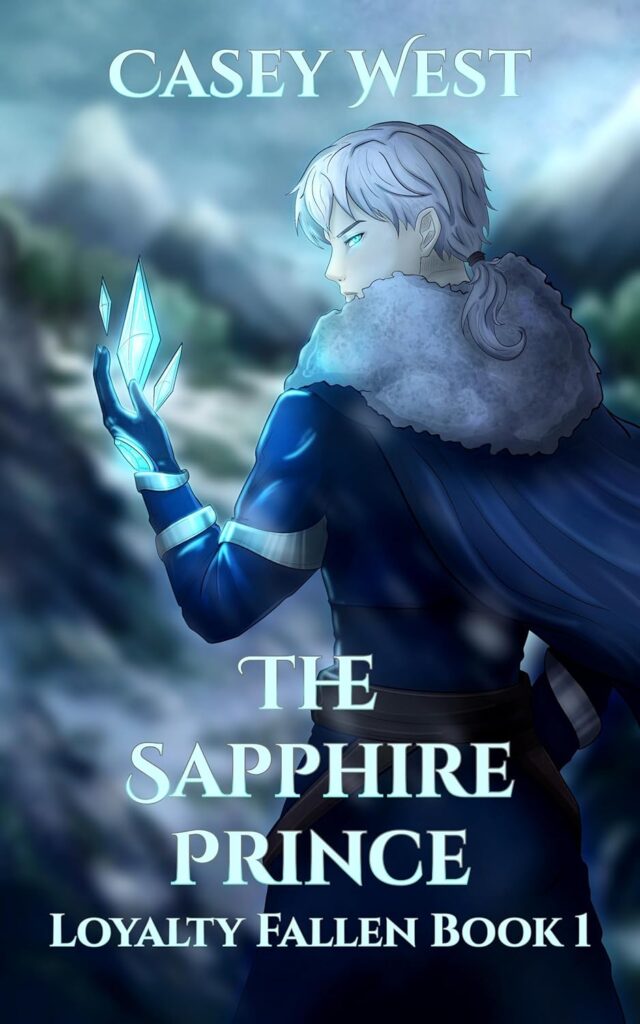
First, the story itself. Book 1 of the “Loyalty Fallen” series (everything’s a series, these days, and I’m just as guilty), here we have a delightful introduction of a cadre of fantasy characters, their love triangles, and their political problems, in a style that tastes a great deal like its manga-flavored cover. A princess and her bodyguard, an unreasonably young and beautiful “honorary” general (so ranked for his unmatched martial prowess, naturally, and naturally sporting long, braidable locks) find themselves on the run after a wedding night gone bad. Where West stands out is in her patience in resting on her protagonists and the grim, unfortunate royal family from which they come. While the characters fall within their anime archetypes, and the work is not striving to be the next “King Leer,” nonetheless the royals have enough complexity to keep us guessing even to the last page—which, since this is a series, is only the beginning of their story, of course. What is prince Illian’s true motivation? Is he a bad guy? A good guy? Something in between? It’s nice to have a simply-written story that manages to raise and sustain questions without making the story itself overly complex.
And that, specifically, because this novel, and presumably the series to follow, are well targeted at the tween and early teen female readership. They are not too complex, not too bogged down in technicalities or psychology, presenting relatively simple and approachable relationship triangles, but several of the main characters (the notable exception being puppy-dog Ren) are nonetheless complex enough in their history and motivation that a young reader will still be wondering how to classify them by the end of this first volume. This is what good fiction is all about: helping us get a window inside people who would ordinarily seem alien or enemy to us.
Overall, the story is well-written and polished, which is a relief in the world of indy/amateur/self-pub fiction. If I have a quibble, it is with missed opportunities. The passage through the mines, stumbling in the dark, beset by opal dragons, happens off screen? No, give me more of that! That should be a whole chapter! For the future, perhaps. Also, on the plus side, West is keeping it clean, for now, so you can give this volume to a young girl without fear that it’s going to drag her down dangerous paths. There will be themes to discuss, but they are suitable for the age range.
That brings me to my two editorial topics. The first is that I miss the traditional paragraph. You know, the kind that had an indented first line but was otherwise adjoined to the paragraphs before and after, spatially. Not the block-paragraph format (with no indentation and a blank line between) which dominates the Internet age. When I was growing up, I was taught that the block paragraph was for professional writing (soulless stuff), and the traditional indented paragraph was for prose, and I think, even if the world has forgotten this, it’s still true. West’s work here is a classic example: Her prose flows, and I suspect she’ll only get better at that as she continues to write and is encouraged to embellish, and the block paragraph interrupts that flow. It also gives the fiction writer fewer tools to work with in terms of scene-breaking. An author writing traditional paragraph format could imply levels of scene break by choosing a simple blank line, a marked break, or a chapter break. But a single blank line no longer means anything in the block paragraph format. More important, though, is that flow. Most paragraphs, in artistic narrative prose, are meant to flow one into the next, to keep the story running like a river, to keep us in the dream, and I think the block format interrupts that at a subliminal level. I would encourage West and other writers to try it out, even in their e-books. Indentation, with no interparagraph vertical space. If you grew up on the internet, and in professional writing, it’ll look dense at first, but clear your mind and just read. See if it doesn’t, in that subliminal way, go down smoother and feel more like storytelling. And, again, it gives you another tool for scene-breaking within a chapter.
The other thing West’s novel has me musing on is how much of what we take for granted about human morality we attribute to humans. This is a classic trope of sword-and-sorcery fiction, and all the moreso in the anime era. Our heroes are against slavery, against torture, against the vicious disposal of young children. They fight for the Good Kingdom in which these things are unconscionable, and we can recognize the bad kingdom because it “still does” these things that the good kingdoms have long ago “advanced beyond.” And who can blame us? Obviously, certain evil practices are evil and only evil peoples do them, and the good peoples would never. It’s an assumption with which we grew up.
It arises, though, from two opposing but coinciding faults: First is an evolutionary theory of morality. It is assumed in popular anthropology that societies “naturally” evolve toward an increased understanding of the value of the human being, the oneness of the family of mankind, and so toward inevitable developments such as the emancipation of slaves and abolition of slavery. Second is a human desire to believe that humans—or at least my tribe of human—is and always has been innately good, and therefore moral advancements, like the abolition of slavery, are an accomplishment of (and creditable to) mankind or my tribe of mankind. Both can’t be true, but you can pick either one and thereby justify a presumption that the right people, given enough time, will produce the moral presumptions you take for granted. This allows the fantasy author to establish his or her good guys with a shibboleth (“the good ones are the ones against slavery”), while also making them comfortable to write, as it justifies us having our protagonists reflect our own morality, and simultaneously allows us to protect our sense of our own righteousness. “I’m a good, fully-evolved person because I recognize slavery is bad, and you can tell because I’ve written my story with good, fully-evolved people as its good guys, who also think slavery is bad.”
West actually teases this trope a little, by having one of her protagonists be an ally to and a supporter of a slaving culture for pragmatic reasons, against a cruel, obviously villainous kingdom which is nonetheless absolitionist regarding slavery. Nicely done. But it’s still the natural assumption in-world among the “good guys” that slavery is bad and the good kingdoms abolished it, and that’s one of the ways you can tell who the “good guys” are.
But why? There’s nothing in the setting, as in any fantasy setting, which would drive any abolition movement, or any moral development of that kind. It’s just assumed that “good people” or “the good kingdom” (same thing) would naturally figure that out and then decide it’s worth fighting and sacrificing their own lives for.
I draw attention to all of this just to point out that this is not the case, and it would be one of my discussion points with my daughter if she were to read a story like this: Did you notice that the “good” people believe slavery is wrong? How did they figure that out? What separated them from the other kingdoms that are still using slaves? Why do they fight for abolition when other kingdoms in the story don’t? Is it in fact a natural and inevitable realization of any sentient/sapient people given enough time? Is there any evidence in the real world to support that? It’s important to bring up because history declares just the opposite: Human beings do not naturally figure out that slavery should be abolished. Quite the opposite: While a few individuals throughout our history occasionally write about it as a necessary evil, there is no abolition movement until the teachings of Christ enter our atmosphere like a meteor bearing an alien pathogen. As detailed in works like Holland’s “Dominion,” the idea of abolishing slavery was absolutely unique to Christendom, occurred very early in Christian history, and had no pre-Christian precursors. There was no trend toward a concept of human rights of which Christianity could be a culmination. The ideas of human equality and of slavery as a thing to be widely abolished and decried were utterly alien to the human mind—and still are today! Where Christian moral and ethical presumptions fade, we see that slavery makes a rapid return in various forms, from government forced labor and organ harvesting operations to open-air slave markets.
And slavery is just one example, and hardly the greatest/worst, of what the human moral compass looks like without a Christian calibration. @InspiringPhilos surveys in the below video scholarly research on what was universally considered the normal treatment of children prior to the Christian moral revolution. Viewer discretion advised, but nothing will clarify your understanding of human nature, and the revolutionary nature of Christian teaching, faster than delving into that topic.
Now, is any of this on West? I would say not. Almost every modern fantasy, set in an explicitly or implicitly non-Christian fictional world, retains entirely Christian moral assumptions which anthropology tells us could not arise without the intervention of Christ and which evaporates within a generation after a culture abandons his teachings. It’s just how we write, because, Christian or not, as Holland devotes his book to describing, we have all been infected by the obvious truth of it. I would still absolutely recommend stories like West’s to a daughter or niece of the target age. And we will all continue to write this way, because we can’t help it. These moral ideas are so intrinsic to us now that we can’t help but attribute them to ourselves and to our species, even though we and our species had nothing to do with them, and none of us outside a Christian context would ever have imagined that the sexual or violent use of our own children was bad, much less the use for forced labor of war captives. We honestly wouldn’t want our children’s fantasy works to be written with an accurate portrayal of sapient morality as it arises without Christ’s interference. The more you dig into it, the more you realize how traumatizing an accurate portrayal would be.
But it is, and this is my ultimate point, worth talking about with a child. It’s worth discussing why we think these things are bad, and how we retain a culture that thinks these things are bad, and perhaps moreover, what happens when a culture starts to think that it considers these things bad thanks to its own natural wisdom, evolved or innate, rather than crediting such developments to their proper source. It is that last mistake which is contributing much to the violence emerging in modern Western society. Convinced that it invented morality all on its own, without any help from the God Who Became Man, it then convinces itself that it has a good idea of when moral precepts can be bent or broken, or when certain behaviors can be morally contextualized. In simple terms, because we figured out “Nazis bad” all on our own, we are naturally empowered to hate and kill Nazis, and also to figure out who are the modern Nazis whom we can hate and kill. And every faction has figured out that the other factions are the modern Nazis. (Rather than recognizing the true lesson of the Nazis, supported by every scientific study on the subject: that we are all naturally Nazis and would all do the horrible things they did, given half a chance and a social justification.) This kind of moral corruption—the corruption of a moral precept to justify immorality and cruelty—is inevitable in human beings when they idolize morality while claiming it as their own invention.
So, as we enjoy our simple pleasures in fiction, and share stories like West’s with our youngin’s, let them be a jumping off point for helping our children understand (as befits their age) where real moral wisdom comes from and on whom we must depend for a morality that is always true and never changes.
UPDATE: I have since had the pleasure of speaking to the author about this issue, and she says, cryptically, “Stay tuned.” So, stay tuned! I plan to. Overall, The Sapphire Prince is fit for reading, and I hope West continues to grow as a writer as she grows her story. I look forward to seeing what she has in store.